Skip to product information
1 of 2

SKU:62313

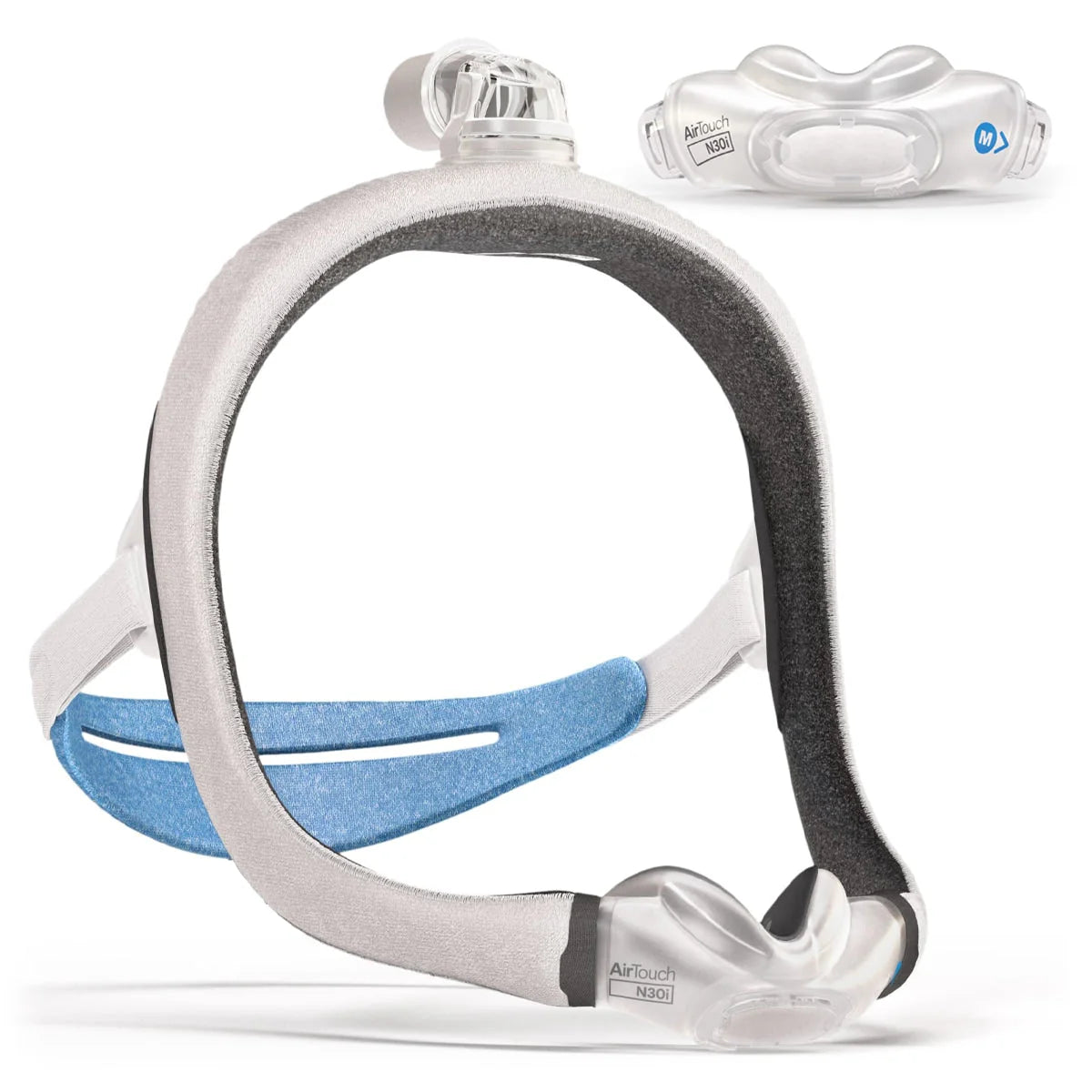
ResMed AirTouch N30i

ResMed AirTouch N30i

Cushion Size
Frame Size
Quantity
Please login to see the price
Shipping calculated at checkout.

What makes the N30i different from a standard nasal mask

Most nasal CPAP masks seal by pressing a cushion against the bridge of the nose, the cheeks, and the area above the upper lip — covering the nose entirely and relying on consistent pressure across a large surface to hold the seal. The N30i doesn't work that way. Its cushion is a nasal cradle: a curved piece that sits beneath the nose rather than over it, pressing gently against the soft tissue just below the nares. The nose bridge is never touched. The cheeks are never touched. The cushion's entire contact area is the narrow band of skin between the base of each nostril and the upper lip.

This geometry matters for two reasons. First, it eliminates the main cause of overnight pressure marks — there's nothing pressing against the cartilage and bone of the nasal bridge while you sleep. Second, it means the sealing surface moves with facial soft tissue rather than against the rigid underlying structure, which is why the cushion stays in place even with minor positional shifts during the night.

The N30i won a Red Dot Award in 2025 for product design — mentioned here because the underlying design work is genuinely notable, not as a marketing point.

ComfiSoft: why fabric instead of silicone

If you've used the AirTouch N20, you may expect the AirTouch name to mean memory foam. It doesn't, in this case. The AirTouch N20 uses an UltraSoft memory foam cushion; the AirTouch N30i uses a different material entirely — a silicone-coated fabric that ResMed calls ComfiSoft. These are not the same product, and the distinction affects how the cushion behaves.

The ComfiSoft cushion has a silicone core that provides the structural integrity needed to hold a seal under therapy pressure. Over that silicone, the sealing surface is woven fabric. The fabric is breathable and moisture-wicking, which means it dissipates the heat and humidity that accumulates under a solid silicone cushion over the course of a night. Patients who notice facial heat, sweating, or irritation at the mask-skin interface with silicone cushions are often more comfortable with this material because there's no occlusive layer trapping warmth against the skin.

The fabric surface also has more grip than smooth silicone. A polished silicone cushion needs to be positioned precisely and strapped firmly to stay sealed, because it will slide if the headgear isn't under tension. The ComfiSoft fabric resists small positional shifts, which means the headgear doesn't need to be tightened as hard to maintain a reliable seal. This reduces the likelihood of the cheek or temple pressure that overtightened headgear causes.

One practical note: because the fabric absorbs facial oils in a way that silicone doesn't, ResMed recommends replacing the ComfiSoft cushion every two weeks rather than monthly. The fabric doesn't degrade from oils the way foam does, but it becomes harder to clean thoroughly over time. Factor this into your replacement supply plan.

The SpringFit frame

The N30i's frame carries pressurised air from the hose connection at the top of the head down each side of the face to the cushion. Unlike a conventional mask frame made of rigid plastic, the SpringFit frame is designed to flex and bend, adapting to facial contours rather than imposing a fixed shape on them. The critical additional detail is that the entire frame — every surface that contacts the face or hair — is wrapped in the same moisture-wicking fabric as the cushion.

The practical result is that almost no bare plastic or silicone touches your skin or hair anywhere along the mask's contact area. For patients who wake up with red marks from the plastic arms of a conventional mask pressing against their cheekbones during the night, this is the relevant structural difference: the frame arms that run down the sides of the face are fabric-wrapped throughout, so they leave the same impression as fabric resting against skin rather than hard plastic.

The tube-up connection: how it works and who needs it

The "i" in N30i designates the hose connection location. On a standard nasal mask, the hose connects at the front of the face, typically at the forehead or nose. On the N30i, the hose connects at the crown of the head via a swivel elbow that rotates freely through 360 degrees.

The mechanical consequence of a top-of-head connection is straightforward: when you roll from your back to your side, or from your side to your stomach, the geometry between your head and the hose inlet doesn't change. The hose is above you regardless of which direction you face, so it follows the turn without pulling against the cushion seal. With a front-entry mask, turning over pulls the hose to one side, which torques the cushion against the face and breaks the seal — or keeps it from breaking only by applying enough headgear tension that the mask is uncomfortable the entire night.

This makes the tube-up design specifically useful for side sleepers, position-switchers, and stomach sleepers. If you sleep in one position without moving, the front-entry geometry of a standard nasal mask is not a problem for you. If you move during the night, the top-of-head connection removes the main mechanical cause of mid-night leaks.

The swivel elbow at the crown also functions as a quick-release disconnect. Squeezing the elbow decouples the hose from the mask, so you can get up during the night — to use the bathroom, answer a phone, walk to another room — without removing the headgear. The mask stays on your face; only the hose is removed. This is a minor convenience most nights and a meaningful one on the nights it matters.

With no hose running in front of the face, the N30i also leaves your full field of view unobstructed. If you read before bed, watch television, or simply want to have a conversation with a partner without the hose swinging in front of you, that's available with this mask in a way it isn't with front-entry designs.

N30i or P30i?

The AirFit P30i is the closest sibling to the N30i: it's also a tube-up "i" series mask, also designed for position-switchers, also uses the same headgear. The difference is the cushion type.

The P30i uses nasal pillows — small silicone inserts that fit a short distance into each nostril to create the seal from inside. The N30i uses the ComfiSoft nasal cradle that seals against the outside of the nose. If you're deciding between them, the question is whether nostril insertion is tolerable for you and whether your therapy pressure supports a pillow seal.

On nostril insertion: some patients adapt to pillow cushions quickly; others find the sensation uncomfortable throughout, either from irritation of the nostril tissue itself or from a reaction that feels physically confining. The nasal cradle approach never enters the nostril at all, which removes that source of discomfort entirely. If you've tried nasal pillows from any manufacturer and found the insertion uncomfortable, the N30i's cushion geometry will feel categorically different.

On therapy pressure: nasal pillow cushions create a smaller sealing surface than a nasal cradle cushion, and at higher therapy pressures — roughly 12 cm H₂O and above — a pillow seal becomes harder to maintain. The air pressure works against the small contact area of the pillow and can push the cushion away from the nostril, requiring more headgear tension to compensate. A nasal cradle cushion presents a larger, softer sealing surface that conforms more readily under higher pressure. If your prescribed pressure is in the upper range, the N30i is the more mechanically reliable choice between the two.

Patients with beards or significant facial hair tend to do better with the N30i than with nasal pillows. The P30i's seal is at the nostril opening, where facial hair typically doesn't interfere, but the more rigid silicone of the pillow doesn't conform around hair the way the N30i's fabric cushion does.

N30i or N20?

The AirFit and AirTouch N20 are the most widely used nasal masks in ResMed's lineup and the masks most patients arrive from when they switch to the N30i. The N20 is a traditional nasal mask: silicone or memory foam cushion that covers the nose entirely, front-entry hose connection, magnetic clip headgear.

The differences are structural, not incremental. The N20 connects at the front of the face, which means any hose drag from turning over during the night acts directly on the cushion seal. The N30i's top-of-head connection removes that mechanical coupling entirely. If you sleep in one position, this doesn't affect you. If you turn during the night and repeatedly wake to adjust your mask or find your therapy data showing leak events, the hose connection location is the most likely cause.

The N20's cushion covers the nasal bridge. For most patients this is fine, but for patients whose skin reacts to sustained pressure overnight — specifically the bridge of the nose, where cartilage provides no cushioning against the mask — this is the point of irritation. The N30i doesn't contact the nasal bridge, so that source of irritation doesn't exist with this mask.

The N20 (AirFit version) uses magnetic clips to fasten the headgear. These are convenient but not suitable for patients with pacemakers, cochlear implants, or other implanted electronic or magnetic devices. The N30i contains no magnets anywhere in its construction and is safe for patients with implanted devices.

The fabric-wrapped SpringFit frame of the N30i also means less rigid contact along the cheeks and temple compared to the N20's harder frame. For patients who notice red marks along the mask frame rather than just at the cushion, the N30i's construction addresses this directly where the N20 doesn't.

Sizing: two dimensions, not one

The N30i has two independent sizing dimensions, and they don't predict each other. Before adding to cart, you'll need to select both a Cushion Size and a Frame Size using the two separate dropdowns on this page.

Cushion size (Small Wide / Medium / Large) is determined by the dimensions of your nostril base — specifically the width of the space between the base of both nostrils and the depth from the nostril base to the upper lip. Medium is the most common starting point for new patients, and if you have no other information to go on, beginning with Medium is reasonable.

Small Wide requires a specific explanation because the name is counterintuitive. It is not a size between Small and Medium on a height scale. It is a width variant: for patients whose nostril base is wider than a Medium cushion can accommodate, but whose nose isn't tall enough to require a Large cushion. A patient who tries a Medium and finds it pulls to the sides or can't create a gap-free seal at the outer edges of the nostrils — rather than at the top — likely needs Small Wide rather than Large.

ResMed provides a printable sizing guide for the N30i. The process involves pressing your bottom lip forward against a printed measurement template to estimate the distance from the base of your nostril to your upper lip — this measurement, combined with nostril width, determines which cushion size fits correctly. The sizing guide video is available on ResMed's website and takes about two minutes to complete.

Frame size (Standard / Small) is determined by overall head circumference and the fit of the headgear against the back of the head. Standard fits the majority of patients. Small is for patients with narrower faces and smaller head circumferences — typically if the Standard frame's headgear arms extend too far past the ears or if the frame tubes sit higher than the nostrils even when fully adjusted. If you've worn the AirFit N30i before and know your frame size, use that; the AirTouch N30i uses the same frame sizing.

Cushion size and frame size are selected independently. A patient with a Large cushion may use a Small frame, and vice versa. Select both before adding to cart.

What's in the box

Each N30i package includes the AirTouch N30i nasal mask with a ComfiSoft cushion in your selected cushion size, a SpringFit frame wrapped in soft fabric in your selected frame size, adjustable soft fabric headgear, the quick-release swivel elbow for the top-of-head hose connection, and a user manual. The mask is compatible with all standard CPAP and APAP machines from ResMed and third-party manufacturers.

SPECIFICATIONS

Cushion sizes: Small Wide, Medium, Large
Frame sizes: Standard, Small
Pressure range: 4–30 cm H₂O
Materials: Silicone-coated fabric (ComfiSoft cushion), fabric-wrapped SpringFit frame
Not made with natural rubber latex
DEHP-free
Cushion replacement: every 2 weeks
Frame replacement: every 3 months
Headgear replacement: every 6 months

WARRANTY

30 Day Mask Guarantee

PACKING LIST

AirTouch N30i nasal mask with ComfiSoft cushion (in selected size)
SpringFit frame (in selected frame size)
Adjustable soft fabric headgear
Quick-release swivel elbow
User manual

View full details