


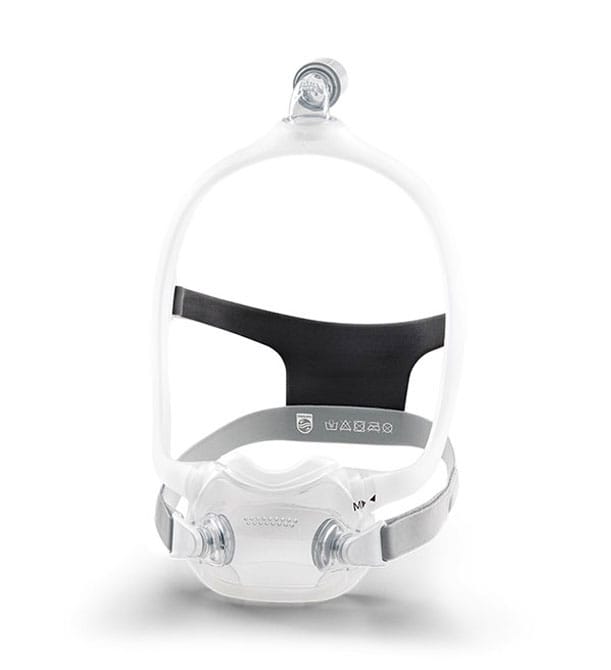
Philips DreamWear Full Face Mask
In stock
- Free shipping over $75
- 30-night fit guarantee Try your mask for up to 30 nights. If it doesn't fit, send it back for store credit toward another size or style. Unopened masks can be returned for a refund or store credit.
- Price match guarantee
Overview
The Philips DreamWear Full Face covers your mouth with a cushion that rests beneath your nostrils, leaving the bridge of your nose free of contact. Air travels through the soft frame to a hose that connects at the top of your head, out of your way.
Night to night, the open design is what you'll notice. You can wear glasses, read or scroll in bed with the mask on, turn onto either side without the hose dragging across you, and unclip the hose at the quick release when you get up.
Key features:
- Two-step sizing: Pick your cushion from Philips' gauge under your nose, then a frame size based on where the mask sits on your head.
- Nasal size carries over: If you already wear the DreamWear nasal mask, your cushion size carries over, since both cushions are sized by your nostrils.
- Swap cushion styles: The same frame also takes DreamWear nasal and pillows cushions, each paired with its own headgear.
- Made without latex: Philips makes the DreamWear Full Face without natural rubber latex or DEHP, helpful if you're sensitive to latex.
- Licensed in Canada: Health Canada lists every frame and cushion size we sell under this mask's active Class II device licence.
The DreamWear Full Face suits mouth breathers who wear glasses or read in bed, people tired of red marks on the nose, and side sleepers. If you'd like an under-the-nose full face mask without magnets, the F&P Evora Full is worth a look.
Note: The headgear clips and cushion contain magnets. If you, a bed partner or anyone close to you has a pacemaker or other implant that magnets can affect, call us before ordering.
How it works
Fitting the mask
With the mask assembled, set the cushion under your nose and rest the frame on top of your head. Pull the headgear over the back of your head and attach the magnetic clips to the cushion.
Peel back the headgear tabs, set the top straps and then the bottom straps, and press the tabs closed. The elbow should sit on top of your head. A little escaping air is normal, so don't overtighten. To take it off and keep your settings, pull the cushion forward from your nose, then lift it up and off.
Daily and weekly cleaning
Each day, hand-wash the frame, cushion and elbow in warm water with liquid dish soap, making sure no air is trapped inside, then rinse and let them dry fully. Once a week, those parts can also run through the dishwasher on the top rack, with the drying cycle off.
Wash the headgear and fabric wraps by hand weekly and lay them flat or hang them to dry, never in a clothes dryer. Avoid bleach, alcohol and cleaners with conditioners or moisturizers.
Additional information
This listing is for patients who already know their DreamWear Full Face frame size and cushion size: returning users reordering a confirmed combination, patients who were fitted at a CPAP clinic, or patients who identified their size from the FitPack and are now replacing a worn cushion. You'll select both your frame size and your cushion size before adding to cart.
Not sure of your frame size, or buying the Full Face for the first time? The DreamWear Full Face FitPack comes with both the small and medium frames and the cushion size you choose, so you can find your frame size at home before committing to one. Because the Full Face cushion must seal at two contact zones, not one, getting the size right before reordering matters more here than it does with the Nasal version.
What makes the DreamWear Full Face different from a traditional full face mask
Most patients who arrive at this page are expecting something like an AirFit F20, a mask that wraps in a triangular seal from the nasal bridge, down both sides of the nose, across the upper lip, and around the chin. The DreamWear Full Face is not that mask. It belongs to a different mechanical category.
The DreamWear Full Face is an under-the-nose full face mask. The cushion sits beneath the nose, in the same location as the DreamWear Nasal cushion, and never contacts the nasal bridge, the top of the nose, or the sides of the nose. There is no forehead pad. There is no forehead stabilizer. There is no hose at the front of the face. What makes it a full face mask is that the cushion extends downward from the nasal base to also cover the mouth, forming a sealed enclosure that delivers therapy air to both the nose and the mouth simultaneously.
If you breathe through your nose only and have no chronic congestion, the DreamWear Nasal mask is likely the more appropriate choice.
How the Full Face cushion seals: two contact zones, not one
The DreamWear Nasal cushion has one sealing zone: the base of the nostrils. The Full Face cushion has two.
The first zone is identical to the Nasal: the cushion seats beneath the nostrils and delivers therapy air upward into both nasal passages without inserting into the nose and without touching the nasal bridge. This is the same under-the-nose geometry, at the same location on the face, with the same absence of contact at the top of the nose.
The second zone extends downward from the nasal base across the upper lip and around the mouth, forming a sealed enclosure over the oral opening. Air delivered through the frame reaches both the nostrils and the enclosed mouth cavity. The mouth need not be closed for therapy to work: the seal contains whatever the patient breathes through.
What is absent is equally important to understand. Because the cushion sits entirely below the nose, there is no contact at the nasal bridge, the zone where traditional full face masks create the most pressure, redness, and long-term soreness. The field of view above and to the sides of the face is completely unobstructed. There is no silicone crossing the nose from any direction.
Exhalation ports are built into both the cushion and the swivel elbow at the crown of the head. Exhaled air disperses upward from the top of the head rather than forward toward a bed partner, which is a consequence of where the hose connection sits, not just where the ports are placed.
How airflow moves through the mask
The frame routing is the same as the DreamWear Nasal. Therapy air enters through the elbow at the crown of the head, splits into two silicone channels running down through the frame arms on either side of the face, and meets at the cushion beneath the nose. The frame carries the air: there is no external hose at the front of the face, no rigid housing bridging the nose, and nothing between the patient's eyes and whatever they're looking at.
What changes between the Nasal and Full Face versions is what happens at the cushion. Where the Nasal cushion delivers air only upward into the nostrils, the Full Face cushion delivers air into both the nasal passages and the enclosed oral space. The frame delivering that air is the same frame.
Who needs a full face mask, and who should use the nasal version instead
A full face mask is indicated when therapy air cannot be reliably delivered through the nose alone.
The most common reason is mouth breathing during sleep. When a patient on a nasal mask opens their mouth, pressure escapes through the oral opening and therapy fails, often without the patient waking up enough to notice. A full face mask encloses the mouth as part of the seal, so therapy continues regardless of whether the patient breathes through the nose, the mouth, or both.
Chronic nasal obstruction is the second major driver. Patients with year-round allergies, chronic sinusitis, a deviated septum, or nasal polyps may find that nasal-only delivery becomes unreliable whenever congestion is high. The Full Face cushion allows therapy to continue through whichever airway is open on a given night.
If you breathe through your nose only and have no chronic congestion, the DreamWear Nasal mask will provide a less intrusive seal with a smaller cushion footprint. The Full Face is not a better version of the Nasal. It is a different clinical tool for a different airway situation.
Sizing: frame size and cushion size are independent
The DreamWear system has two separate sizing dimensions, and this listing requires you to specify both. Frame size governs the physical fit of the silicone tube frame against your face: the length of the arms, the width of the frame, and where the headgear attaches. Cushion size governs whether the under-the-nose seal seats cleanly at both contact zones without lifting, pressing into the nostrils, or leaving gaps at the sides or around the mouth.
These dimensions do not predict each other. A Large frame does not mean a Large cushion. It is entirely common to combine a Large frame with a Small cushion, or a Small frame with a Medium Wide cushion. If a clinic fitting or a prior FitPack trial gave you a specific combination (for example, "Medium frame, Medium Wide cushion"), that is what you select here.
Philips says the medium frame will comfortably fit most faces, and recommends starting with it if you're unsure of your frame size.
If you're ordering the Full Face for the first time and haven't been fitted, the DreamWear Full Face FitPack is the appropriate starting point. Philips provides a sizing guide specific to the Full Face cushion, which can be downloaded from this page. Taking the time to confirm your cushion size before ordering is worth the effort.
Headgear, magnetic clips, and hose attachment
The Full Face headgear attaches to the cushion with magnetic clips. The clips allow the headgear to be removed and reattached without threading anything: the mask comes off and goes back on as a unit.
The elbow at the top of the head has a tubing quick release, so the hose comes away without removing the headgear when you need to get up in the night. Because the hose connects at the top of the head, it follows your head through position changes rather than dragging against the pillow.
Replacement schedule
Philips does not set a fixed replacement schedule for this mask. Its useful life depends on how it is used and cared for, so inspect the cushion, frame and headgear regularly and replace any part that is worn or damaged.
What's in the box
Each kit includes the DreamWear Full Face frame in your selected size, the Full Face cushion in your selected size, the headgear with magnetic clips, the top-of-head swivel elbow, fabric wraps for the frame arms, and the user manual.
The frame, cushion, headgear, and elbow are each available separately as replacement parts. The cushion and frame use the same clip-in connection point across all three frame sizes: a Small cushion fits a Large frame, and a Medium cushion fits a Small frame.
What's included
- DreamWear frame in your frame size
- Full face cushion in your cushion size
- Full face headgear with magnetic clips
- Elbow with tubing quick release
Specifications
- Mask type
- Full face, cushion under the nose and around the mouth
- Cushion sizes
- Small, Medium, Large, Medium-Wide
- Frame sizes
- Small, Medium, Large
- Hose connection
- Top of the head, with tubing quick release
- Pressure range
- 4 to 30 cm H2O
- Sound level
- 16.5 dBA sound pressure at 1 m, 24.0 dBA sound power
- Dead space
- 179 to 204 mL on the Medium frame, by cushion size
- Magnets
- In the headgear clips and cushion
- Magnet distance
- Keep at least 15 cm from implants magnets can affect
- Frame
- Soft silicone, optional fabric wraps
- Materials
- No natural rubber latex or DEHP
- Health Canada licence
- 100043 (Class II)
 Philips DreamWear Full Face Mask$204.00
Features and fit
Getting used to the airflow
Breath leaves through two large vents and a few small holes in the cushion, and through the elbow, so the air isn't pushed out of one port. Philips says the airflow runs closer to your ears, so some people notice it more at first. It's not louder, just different.
- Check the two large vents are clear before each use
- Thin flaps behind them close once the machine is running
Taking the mask off and on
To keep your strap settings, grip the cushion, pull it forward away from your nose, then lift it up and off. When you need to get up in the night, pull the tubing quick release and the hose comes away from the mask.
- Optional fabric wraps slip over the frame arms
Magnet distance and who it covers
Philips and Health Canada say to keep the mask at least 15 cm from any device or implant that magnets can affect. That includes everyone else in the room as well as you.
- The list also covers insulin pumps, hearing or balance implants, magnetic denture attachments and metal splinters in the eye
- Philips tightened this warning in 2022, so go by the current figure if an older guide says less
Machines and parts that fit
Philips publishes the specifications your care provider uses to match a mask to your machine. On a Philips DreamStation, your provider also sets the mask type for the best comfort.
- Cushions in Small, Medium, Large and Medium-Wide
- Frames in Small, Medium and Large
- Full face headgear, and its magnetic clips
- The frame also takes DreamWear nasal and pillows cushions
Under-nose cushion
The cushion sits under your nose and around your mouth, with nothing resting on the bridge of your nose. Philips designed it to end the red marks a bridge-contact mask can leave.
Top-of-head hose
Air flows through the hollow frame to a hose that attaches up at the crown of your head. The hose stays out of your way, whichever side you sleep on.
Open view
With no frame in front of your eyes, you can wear glasses, read or use a tablet in bed with the mask on. Philips built the open design for exactly that.
Magnetic clips
The lower headgear clips snap onto the cushion with magnets for quick on and off. Because of the magnets, read the safety note before ordering if you or a bed partner has an implant.
Common questions
How often should I replace DreamWear Full Face parts?
Philips doesn't set a fixed schedule for this mask. It asks you to inspect the mask every day and replace any part at the first sign of wear or damage, rather than waiting for a date on the calendar.
How do I find my frame and cushion size?
Size the cushion first: hold Philips' sizing gauge under your nose and choose the smallest cushion that fits. For the frame, start with Medium. If it slides back toward your ears, go smaller, and if it sits close to your eyes, go larger.
Can I wear glasses with the DreamWear Full Face?
Yes. Nothing sits in front of your eyes, and Philips designed the open frame so you can wear glasses, read or use a tablet before you fall asleep. The hose joins the frame on top of your head, out of your line of sight.
Is the DreamWear Full Face safe with a pacemaker?
No. Philips and Health Canada say not to use it if you, a bed partner or anyone close by has a pacemaker, defibrillator, neurostimulator, shunt, metal stent or other implant that magnets can affect. Call us and we'll help you choose a mask without magnets.
Does my DreamWear nasal cushion size carry over?
Yes. The full face cushion is sized by your nostrils, just like the DreamWear under-the-nose nasal cushion, so a Medium nasal means a Medium full face. Amara View sizes don't carry over, because that mask sizes differently.
Do I need a prescription to buy this mask?
No. Masks don't need a prescription, so you can order this one straight away. We only ask for a prescription with CPAP machines and ventilators, before they ship.
Need help?
Between two sizes, or not sure which mask suits you? Call or chat with our team before you order.